

Week Two: A Fractured Schedule and the Gift of Mangoes
Dispatch Two from the CVUSD Summer Pilot
There’s a question that sits underneath everything I’m doing out here, and it’s not exactly about reading at all.
It’s whether this thing I built works when conditions aren’t ideal. Not in my living room with Demi, where I controlled every variable. Not in a polished demo, with a child whose parent I know is committed to learning. This is unfolding in a real public school, in summer, with a fractured schedule and kids I’d never met, with circumstances that change by the hour. Anyone can build something that works in perfect conditions. The harder and more honest test is what happens when the conditions fall apart.
This past week was that test. And I learned more from it than I expected to.
What a Real School Week Looks Like
Midway through the week, North Shore had a hand, foot, and mouth outbreak. For anyone who hasn’t dealt with it, it moves fast through young kids and it’s the kind of thing you take seriously. It’s common in farm-heavy regions. Two of our volunteers there made the call not to attend the remaining sessions on Thursday and Friday.
When they asked me what I thought, my answer was immediate. Safety first. Always. There is no version of this pilot where we put volunteers or children at risk to protect a schedule. The work is important, but it is never more important than the people doing it. We adjusted, we lost some sessions, and that was the right thing to do without a second of hesitation.
So week two got shorter on top of an already compressed timeline. Between part-time volunteer schedules, the Juneteenth holiday that closed last week, and now an outbreak at one of our two sites, the seventeen-day plan I walked in with has become something more improvised. I’ve stopped thinking of it as a plan with a fixed shape and started thinking of it as whatever days we actually get, used as well as we can use them.
This is what institutional work actually is. Not the ideal version in the proposal. The real version, where a calendar gets thrown off-balance, and you keep going anyway.
What Held
Here’s the part that mattered. Through all of it, the kids kept progressing.
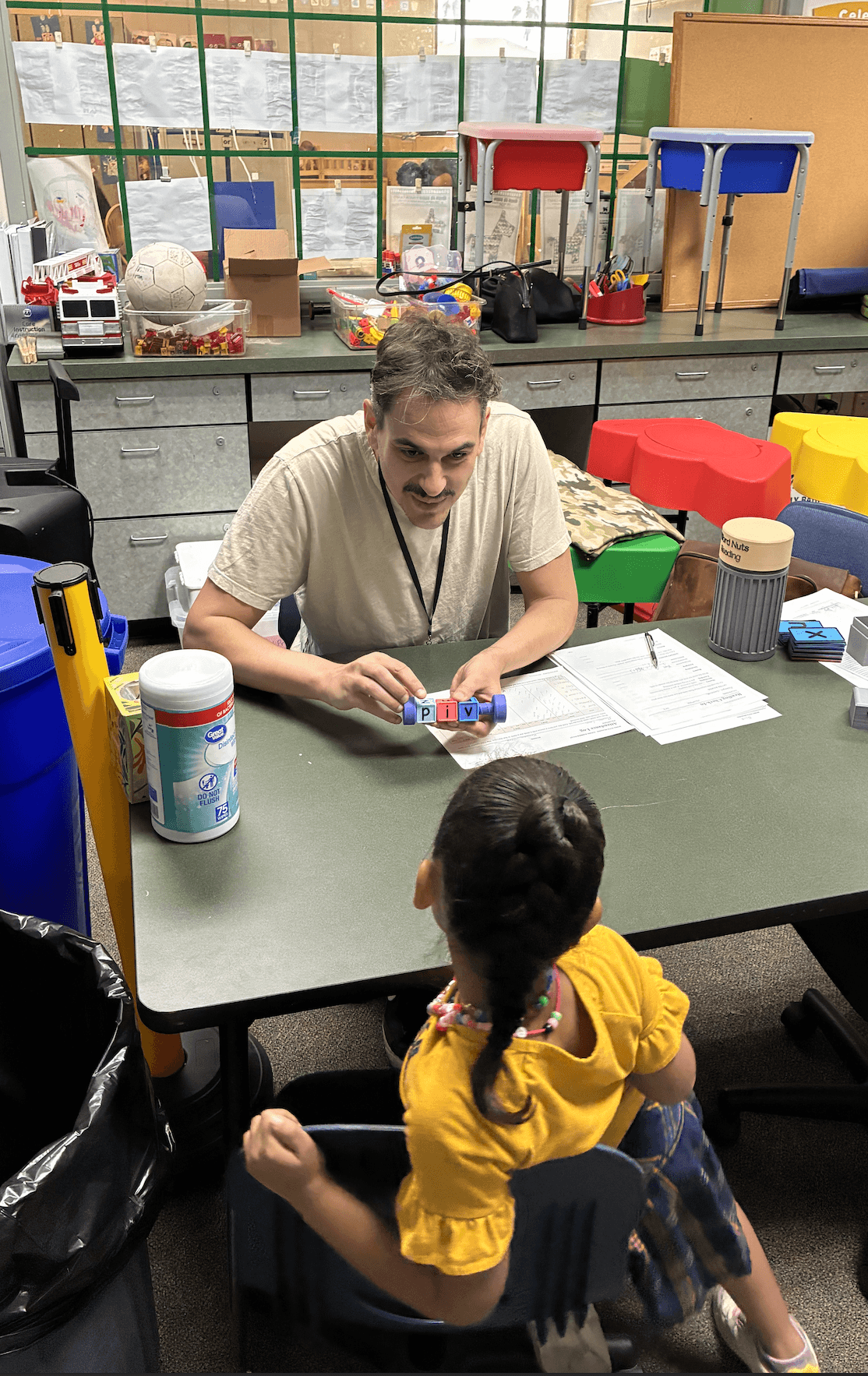
That sounds simple, but it’s the entire point. A system that depends on everything going right is a system that fails the moment something goes wrong, and in a school, something always goes wrong. What I watched in week two is that the work didn’t depend on perfect conditions. A shortened session still produced a blend. A substitute presence didn’t derail a child’s momentum, because the structure of the tool carries the load, not the particular adult holding it. The bolt doesn’t care whether it’s a perfect Tuesday. It does the same job every time.
One of my girls surprised me this week. Blending wasn’t even on her radar when we started. She came in knowing around eighteen letter sounds, and as we worked through the rest, we brought those developing letters onto the bolt to practice them there. Blending was meant to be secondary, a background layer under the letter work. But for her, the blending was exactly what made the letters rock solid. She caught it faster than I expected. By this week she was pulling three sounds into a clean CVC word, steady and unhurried, then glancing up at me with that particular look kids get when they’ve just surprised themselves. That kind of progress wasn’t supposed to be possible in a week this fractured.
Other kids are still only in command of two or three letter sounds, still working the flash cards, still building the foundation. I’m at peace with that in a way I had to grow into. The temptation, when one child is rocketing, is to pour your energy where the visible wins are. The discipline is giving the child struggling with three out of twenty-six sounds the same patient presence and trusting that the foundation is doing quiet work you can’t see yet. Patience is turning out to be the most important thing I bring to that table, more than any technique.
Earning a Place in the Room
I’ll be honest about something that doesn’t always get said.
I am not a classroom teacher, and I don’t pretend to be. But I didn’t arrive empty-handed either. I tutor non-English speakers in reading through the Los Angeles Public Library, and I’ve spent a long time studying the science of how reading actually works, deep in the research on phonics and phonemic awareness, because that’s what it took to build this system in the first place. Still, at the end of the day, I’m just a dad who built a powerful reading tool and walked into someone else’s classroom to use it.
That carries a real responsibility to earn my place there, and not everyone is going to assume I belong on day one. They shouldn’t. A classroom is a teacher’s domain, and a stranger showing up with a 3D-printed device and a case for phonics has to prove the case is worth the disruption.
The teacher whose room I’ve been working in, I’ll call her Ms. M, didn’t wonder about me quietly. She asked me directly whether I was a teacher, whether I’d done reading interventions before. It was a fair question, the kind a good teacher should ask about anyone working with her kids. So the next morning I brought her an iced latte and we spent fifteen minutes going through the system, beat by beat. Then I let the kids show her the rest.
And this week, it turned. On Tuesday, Ms. M brought me mangoes from her tree. Today she gave me eggs from her family’s chickens. If you know the Coachella Valley, you know what that means. That’s someone deciding you’re welcome.
I think about that more than any data point. The institutional case for Word Nuts won’t be won in a spreadsheet alone. It’ll be won in rooms like this one, with people like Ms. M, who ask the hard question, get a real answer, and watch the thing actually work. Trust is the real currency. You don’t get it by claiming you deserve it. You earn it by showing up on the hard days too.
What I’m Carrying Into Week Three
I came out here believing in the system. What this week gave me is something a little different, which is evidence that the belief holds up under pressure. The schedule contorted, and the kids still progressed. One site got disrupted and we made the right call, and kept going where we could. A skeptical room slowly became a welcoming one.
None of that is the finish line. The timeline is still tight and the work ahead is still significant and some of these kids have a long way to go. But I know something now that I only hoped before. This doesn’t just work when everything is perfect. It works when things are real.
Next week, we keep building.
This is the third post in a weekly series documenting the Word Nuts Reading summer pilot in Coachella Valley Unified School District. New updates are posted each Thursday or Friday throughout the program.
Michael Land is the founder of Word Nuts Reading, a sound-first early literacy system built around 3D-printed phonics manipulatives. Patent pending.