

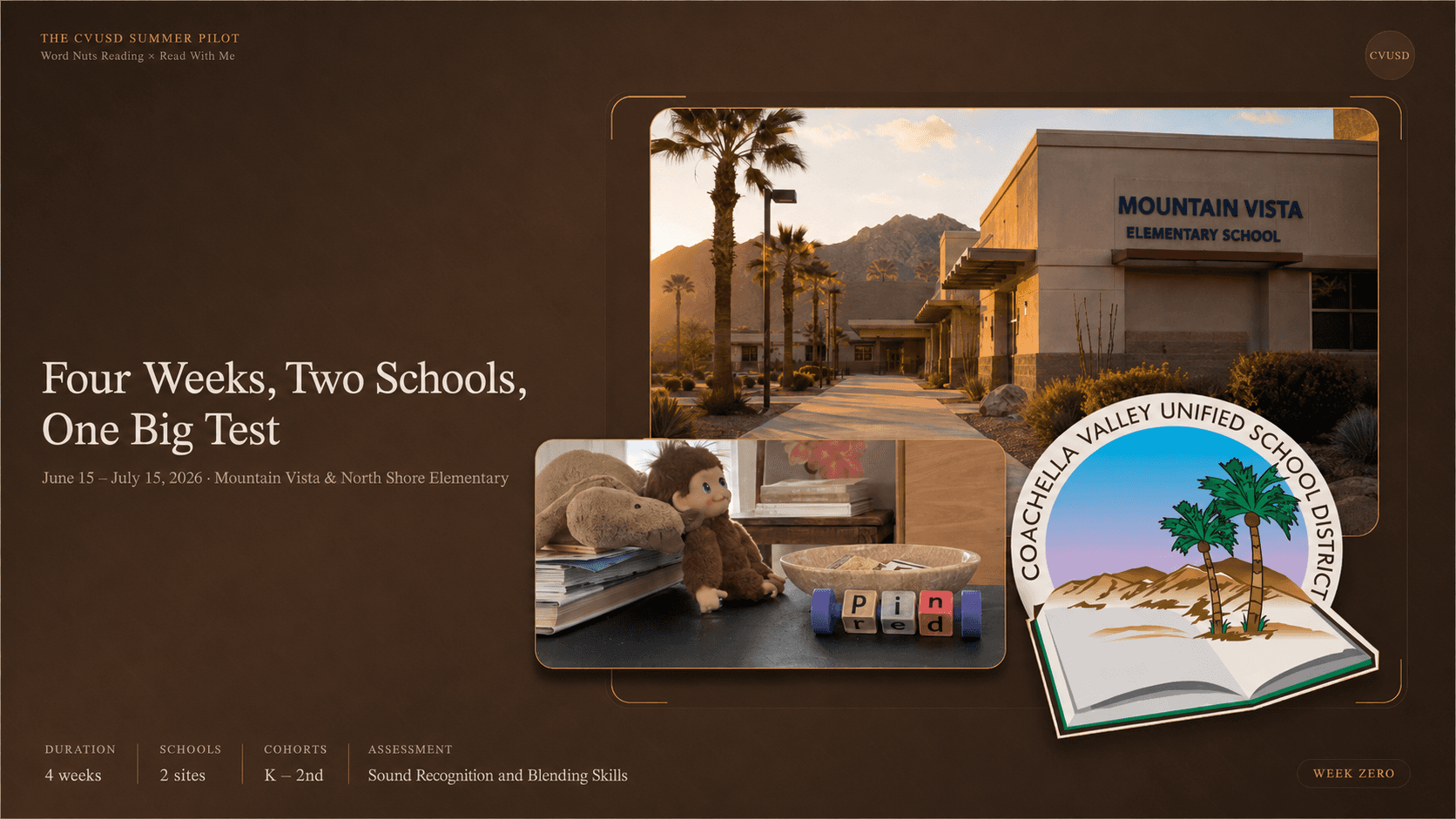
Four Weeks, Two Schools, One Big Test
Five Minutes, a Handful of Times a Week
On Monday morning, I’ll walk into a classroom at Mountain Vista Elementary and sit across from a child I’ve never met. I’ll place a bolt on the table, load three nuts, and point to the first letter. “What sound does this make?”
I’ve done this hundreds of times with my daughter Demi. I’ve done it with volunteers in the desert. I’ve done it at library tables. But this is different. This is a formal pilot inside a public school district, with pre-and-post assessments, structured sessions, and real data on the other side.
I have butterflies in my stomach. And I believe completely in what’s about to happen.
How We Got Here
Word Nuts Reading started the way most things start when your child is struggling: with fear, then research, then building something because nothing on the shelf was doing what it needed to do.
Demi was flagged in TK. Her DIBELS scores weren’t moving in the right direction, and I could feel the gap widening. I went deep into the neuroscience of how reading actually works at a mechanical level and kept arriving at the same conclusion: the problem wasn’t knowledge. Demi knew her letter sounds. She understood the concept of blending. What she didn’t have was the repetition, the controlled structure, the daily reps that would turn that knowledge into something automatic.
So I started 3D printing prototypes at the kitchen table. Rotating letter blocks on a threaded bolt. One sound changes at a time. The spacing between the nuts isolates each phoneme visually and physically. The color coding tells you where everything goes. The whole system is designed so that a parent with no teaching background can sit down for five minutes and run a session that’s structurally sound.
That summer, I ran sessions with Demi almost every day. Five to ten minutes, usually after her bath, low pressure, no stakes. Just the sounds. No other tutoring. No summer school. Just Word Nuts.
By the time Kindergarten assessments came around, she wasn’t just meeting benchmarks. She was testing Well Above Benchmark on every measure her school tracks.
The Desert Connection
I first connected with Read With Me through my parish in the Coachella Valley. At the time, there were no pilots, no library partnerships, no formal anything. I was still in the early stages of getting Word Nuts in front of families and seeing how it lived outside my own home.
I pitched them the system and they agreed to start using it with a few of their volunteers. What happened next is what gave me the confidence to think bigger. Kids were making real progress. Volunteers who had no background in reading instruction were running effective sessions because the tool handled the structure for them. The blending was landing. The sounds were sticking.
Read With Me saw what was happening and opened a door I couldn’t have opened on my own. They connected me with Coachella Valley Unified School District, and together we built a proposal for a structured summer pilot. Four weeks, two schools, daily sessions during the existing language arts block, with DIBELS and i-Ready assessments bookending the whole thing.
That pilot starts Monday.
What the Pilot Looks Like
Mountain Vista Elementary will run five days a week with me and two other volunteers. North Shore Elementary, near the Salton Sea, will run three days a week with its own team. Sessions are one-on-one, about ten minutes per student, working across rising Kindergarten, first grade, and second grade cohorts. The students range from those who need the most support to those already meeting benchmarks.
The assessment structure is what makes this meaningful. Every student will have pre-pilot scores on file. At the end of July, they’ll be assessed again. The question isn’t whether the kids will enjoy the sessions. I already know they will. The question is whether four weeks of consistent, structured phonics practice on the bolt moves the numbers in a way that’s measurable and defensible.
I want to be honest about what that means. Fifteen to twenty instruction days is not a lot. Producing meaningful, measurable gains in that window is a mighty ask for any intervention, let alone one delivered by volunteers with a tool most of these kids have never seen before. I know that. The ideal outcome is clear movement on the assessments. But even a modest shift in the right direction tells us something important, because it means the system is doing real work in a setting it wasn’t originally designed for, with children it’s never met, on a timeline that doesn’t leave room for slow starts. And beyond the numbers, there’s something else I’ll be watching for: the moment a child who struggled with a blend yesterday lands it today and knows they landed it. That kind of progress doesn’t always show up on a score sheet, but it matters to the child who felt it.
That data matters. It matters for the families in the Coachella Valley. It matters for the librarians and literacy coordinators I’ve been building relationships with. And it matters for the broader case that a simple, parent-friendly tool can do serious work in an institutional setting.
Following Along
I’ll be posting weekly updates here throughout the pilot. Not polished recaps. Real dispatches from the ground. What’s working, what’s surprising, what the kids are teaching me that I didn’t expect.
This is the first chapter of a story that started at a kitchen table with a struggling reader and a dad who refused to accept that struggle as permanent. The next four weeks will show whether what worked for Demi can work at scale.
I believe it can. Monday, we find out.
This is the first post in a weekly series documenting the Word Nuts Reading summer pilot in Coachella Valley Unified School District. New updates will be posted each Thursday or Friday throughout the program.
Michael Land is the founder of Word Nuts Reading, a sound-first early literacy system built around 3D-printed phonics manipulatives.