We knew the system worked at home.
We wanted to know if it could work somewhere more challenging.
…Much more challenging.
What we tested:
Could a few focused minutes with a screen-free, tactile, sound-first system strengthen the foundation beneath early reading? Could an adult without formal literacy training use that system with children he had never met before - and still see measurable movement?
The sessions were led by the system’s creator— not a classroom teacher or reading specialist. The system was designed to carry much of the instructional structure itself, giving a non-expert adult a clear routine to follow without having to invent a lesson.
Seven children, 26 letter sounds each, sorted by command level at entry and exit. The children who practiced more often gained more.
A sound was marked Strong Command when the child produced it instantly, Some Command when the child needed a few moments or self-corrected, and No Command when the child could not produce it at all.
The system met children at very different starting points. Two entered the summer program with no command of any of the sounds in the alphabet. Four weeks later, they held four and six in Strong Command, each with four more emerging— a first reliable foothold where none had existed. At the other end, two children who began with 12 and 14 strong sounds finished with instant command of all 26.
Across all seven, Strong Command grew. The same brief, tactile routine opened the pathway for beginners and carried more advanced children to full alphabet-sound mastery.
Then children began putting those sounds together to read words.
Strong Command, child by child
Every child had spent a full year in Transitional Kindergarten
many learned more in the 4 weeks of the pilot than they had in the previous year
E.G.
14
12 → 26
+14
10 of 10
E.D.
11
8 → 19
+11
12 of 12
A.S.
10
14 → 26
+12
4 of 4
V.C.
10
4 → 21
+17
17 of 17
A.C.
8
12 → 17
+5
6 of 11
J.M.
10
0 → 6
+6
7 of 23
J.V.
8
0 → 4
+4
8 of 26
Blending: From Zero to Decoding.
The 16 item CVC decoding check, word by word.
At entry, none of the children in the cohort could blend or decode a single CVC word.
By the final week, four children reached consistent blending. The two present for the formal check read 13 of 16
and 9 of 16 words, each with the light adult support any beginning blender requires.
Any child, at entry.
The child with the most sessions, at exit.
The child with the largest single gain, at exit.
/ 7
/ 7
min

E.C. attended more often than anyone: fourteen brief sessions. She arrived with twelve letter sounds already in Strong Command— a solid beginning, but not quite halfway there.
Day after day, the routine stayed familiar and the sounds became more available to her. By the final check, all 26 letter sounds came instantly. Not only that, she had begun decoding. She blended 13 of 16 words, including pseudo words she'd not regularly encountered before.
A few minutes a day had opened a pathway to real reading.
At the start, every time I held up a flash card, J.V.'s eyes searched for an answer. He wanted to find one. At first, there was simply nothing for him to retrieve. He would look back at me after some moments and say, “I don’t know”, defeated. It was not giving up, it was honesty. Still, he kept asking to be picked. To take the 10 minutes to try.
After eight sessions, he could produce eight sounds, four of them instantly. The searching was still there at the end of the 4 weeks. But for a growing handful of letters, he looked at the shape —and recognized it.
Eight sounds were not the finish line. They were the beginnings of a strong foundation.
V.C. and J.M.'s attention both liked to travel— to the supplies in the supply room, to the noise from other classrooms, anything happening beyond the table. But the device gave them both something easy to return to: turn a block, touch a letter, say a sound, again and again. When her attention wandered, the work did not fall apart. They could simply come back to something familiar, something patient and reliable.
V.C. began with four sounds in Strong Command. Ten sessions later, she could produce all 26. 21 of them instantly— and blend 9 of 16 words with gentle assistance.
She did not have to become a different kind of child before learning could reach her. The system gave her a way back in, as many times as she needed it.
Four other children came through that same small room, and the complete results are available for download by signing up below.

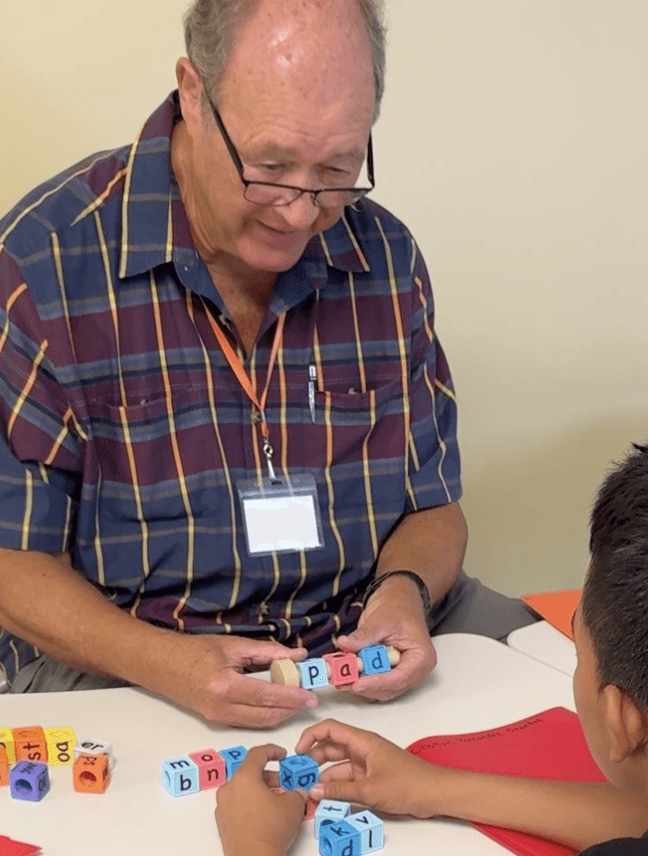
This pilot did not begin in a laboratory. It began because Read With Me opened a door—into two desert schools, into the rhythm of a working summer program, and into relationships with entire communities.
For more than two decades, Read With Me Volunteer Programs has brought caring adults into Coachella Valley schools to help children from low-income, limited-English-speaking communities learn to read, comprehend and speak English—and to know that someone sees their potential. Its commitment extends beyond weekly tutoring, through books for children to keep and its partnership with Riverside County’s Literacy by 5th Grade Initiative.
Executive Director Sean Webb and Alena Callimanis helped make room for this pilot within that larger work. I am deeply grateful for their trust, their practical guidance and their willingness to make room for one more possible way into reading.
The measured findings on this page came from the Mountain Vista cohort. At North Shore, Read With Me volunteers gave us an early look at another important question: how would the routine travel when placed in non-expert hands?
What emerged was quietly important. Volunteers did not need to become reading specialists. They needed a small number of practices they could carry faithfully: stay with the sounds, introduce manageable letter sets, change one part of the word at a time, and keep the experience calm and encouraging.
When that structure held, children found their way into the work— and volunteers found their rhythm within it.
What's next?
This was a small, four-week pilot without a comparison group. The primary cohort was taught by the system’s creator, and attendance varied by child. The findings show measurable movement during the pilot, but they cannot establish that the system alone caused those gains.
The next test is a larger implementation with fully trained instructors, more consistent practice and longer-term follow-up. We are now seeking school, library and literacy-program partners interested in helping us carry out that next phase.

Get the complete pilot report
Inside, you’ll find:
• Entry and exit results for all seven children
• Complete letter-sound and blending findings
• Session frequency and the early dosage pattern
• Additional findings from the Read With Me volunteer cohort
• Implementation observations, limitations and next questions
You’ll receive the report immediately, along with occasional updates as the next phase of Word Nuts Reading develops. Unsubscribe anytime.