

What the Reading Rope Reveals About Real Reading Success
Why Automatic Word Recognition Changes Everything
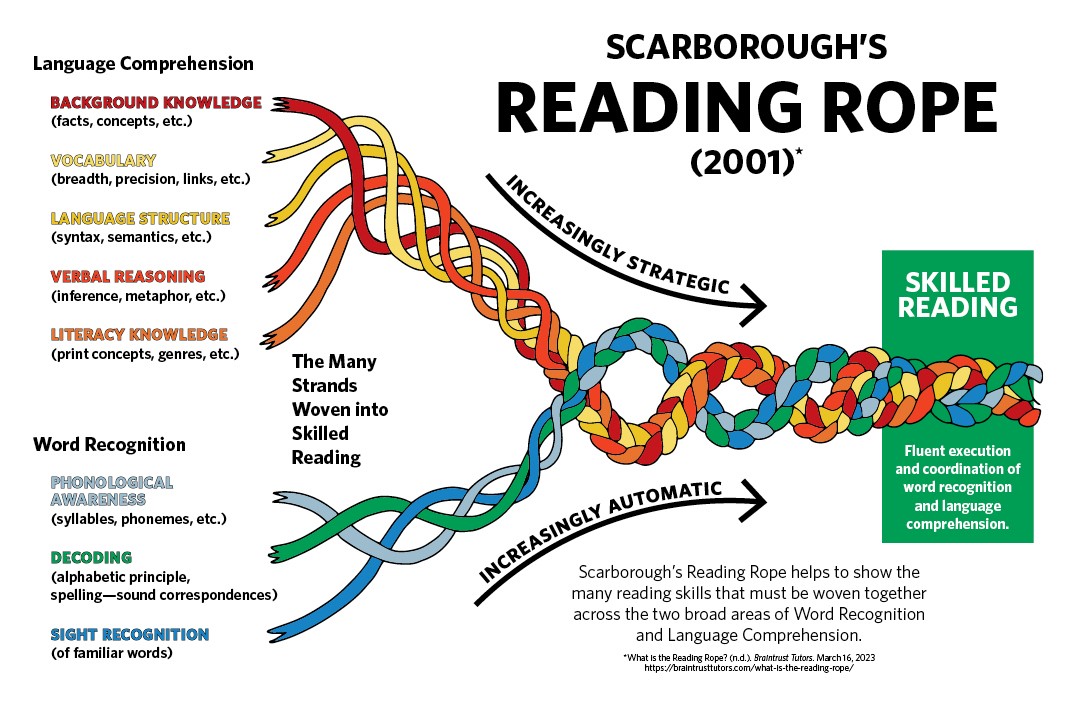
Scarborough’s Reading Rope is often shown as a neat braid of skills (a widely used model of reading development): phonological awareness, decoding, vocabulary, verbal reasoning and others, woven together until fluent reading appears.
In real readers, of all ages, they rarely are.
What the rope doesn’t show is that some strands are asked to carry far more weight than others, depending on how reading develops. And when one strand can’t hold, the rest don’t simply fail. They end up compensating.
That compensation is what we often call guessing, skimming, or reading without precision. But those behaviors aren’t the problem. They’re the visible strain in a system that’s quietly overworking to stay intact.
The Hidden Physics of the Reading Rope
Scarborough separates reading into two broad systems:
Language comprehension: vocabulary, background knowledge, syntax, reasoning
Word recognition: phonological awareness, decoding, sight recognition
The model suggests these strands strengthen together. In practice, they often don’t.
Many readers develop strong language comprehension early. They understand stories, anticipate meaning, and infer effortlessly. Word recognition, however, may never fully stabilize. When that happens, comprehension doesn’t step aside to help strengthen the lower layers of the rope.
It steps up to carry the load.
When Comprehension Starts Carrying Decoding
And while comprehension carrying great load may appear advantageous, the overall strength of the rope suffers. A reader with strong language skills but unstable word recognition can appear fluent for years. They follow the gist. They substitute words that “make sense.” They move forward smoothly.
And from the outside, it looks a lot like reading. Internally, something else is happening.
Instead of tracking sound precisely, the reader is deciding. Instead of receiving words automatically, they are predicting them. Language comprehension begins doing double duty— making meaning and compensating for unreliable word recognition.
Guessing isn’t a bad habit. It’s an adaptive response.
But as texts grow denser, vocabulary less familiar, and context thinner, prediction becomes less reliable— and less forgiving. Substitution begins to distort meaning instead of preserving it. This is often when reading difficulty is finally named, though the instability has been present all along.
By the 5th grade, the rope is asked to carry more weight with less core strength.
What Actually Strengthens the Reading Rope
The Reading Rope doesn’t fail because a strand is missing. It fails because a critical strand never becomes trustworthy enough to step out of the way.
Phonemic awareness, (which I explore in depth in my post on phonemic awareness vs phonics) plays a much larger role than it’s usually given credit for. It determines whether word recognition can ever become automatic.
Not fast.
Not memorized.
Automatic.
Automaticity doesn’t mean speed. It means freedom.
It means sound-to-symbol mapping happens reliably enough that comprehension no longer has to intervene. The reader isn’t deciding what a word might be. They’re receiving what it is.
This is the difference between a rope that looks intact and one that actually holds.
Why Phonics Alone Isn’t Enough
Phonics instruction teaches correspondences. It explains how symbols map to sounds.
But knowing correspondences is not the same as having stable access to sound.
A reader can understand phonics rules and still struggle to hold sounds in mind long enough to compare them. In that case, phonics becomes another decision-making tool rather than a pathway to automatic recognition.
The strand exists— but it’s still bearing weight.
What strengthens it isn’t more rules or more speed. It’s repeated experience with sound change under constrained conditions— where only one variable shifts and guessing is impossible.
When sound becomes reliable, the rope reorganizes.
What Changes When the Strand Holds
When word recognition stabilizes, something subtle but profound happens:
Comprehension stops compensating and starts doing its real work
Pace steadies without force
Accuracy improves without effort
Confidence builds authentically
Reading no longer needs to be managed. The system trusts itself.
This shift is visible in children. It’s just as visible in adults who have read for decades without ease. The relief is often immediate— not because reading becomes simple, but because the underlying structure finally holds.
Rethinking Balance in the Reading Rope
Scarborough’s Reading Rope is not a checklist. It’s a system under tension. It is often asked to lift loads it is not strong enough to carry.
The strength of the Word Recognition rope and —most importantly, its individual strands — is what can lead to fluid language comprehension flourishing later.
When it isn’t, comprehension is forced to prop up poor decoding and as a result, the individual strands rub each other the wrong way, so to speak. They weaken the reliability of the rope, instead of strengthen it.
Understanding this distinction changes how we interpret reading behavior. It shifts the focus away from effort, motivation, or strategy and toward structural integrity. And that shift is often the turning point— when reading stops feeling exhausting and starts feeling like access.
—
Michael Land is an education designer focused on early literacy, phonemic awareness, and phonics-forward reading systems.